
The regeneration of Battersea Power Station represents one of the most significant heritage-led construction projects undertaken in the UK in recent decades.
The building demanded not only architectural sensitivity but also the careful specification of materials capable of preserving its historic character while meeting modern performance standards. Due to Battersea Power Station’s Grade II* listed status, it was essential to reuse as much of the existing fabric of the building as possible.
At its peak, Battersea Power Station was supplying a fifth of London’s electricity. Following its decommission in 1983, the Power Station changed hands numerous times and various ideas were proposed around its redevelopment.
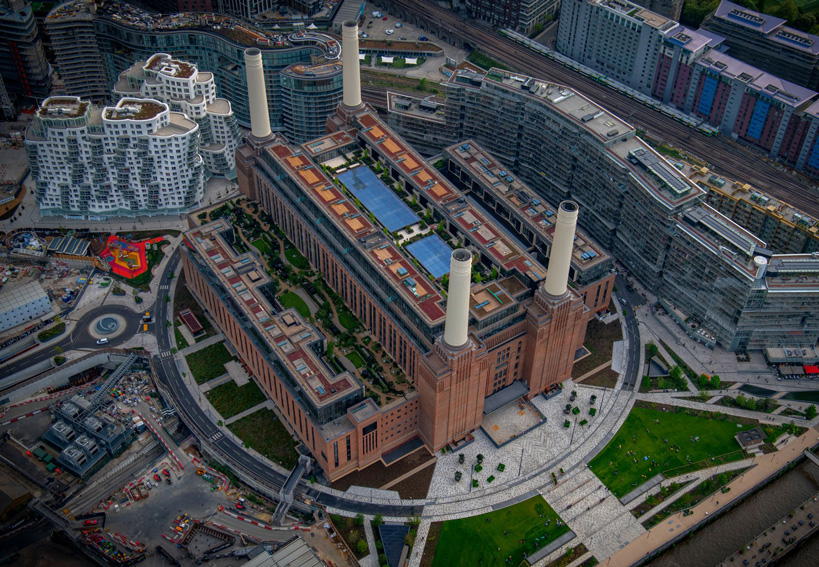 None of these ideas proved feasible and the resulting decades of neglect took their toll. In 1991, the Power Station was added to the Heritage at Risk Register, reflecting the site’s dilapidated condition. It wasn’t until 2012, when the site was bought by a Malaysian consortium, that the fate of the Power Station shifted, and the vision was finally set for what would become one of Europe’s most significant and eagerly awaited developments.
After decades of sitting derelict, it is open to the public as one of London’s most exciting and innovative destinations with over 150 shops, restaurants, and entertainment, including a cinema, an events venue and the glass Lift 109 chimney experience, as well as office space and residential apartments.
For the Mastic Asphalt Council (MAC), this scheme highlights the continued relevance and technical capability of mastic asphalt, especially where durability, adaptability and sustainability are critical.
Delivered by MAC members BriggsAmasco and IKO plc, the waterproofing programme across Phase Two of the development demonstrates how traditional materials, when combined with modern techniques, can meet the challenges of heritage projects. Mastic asphalt was used to protect and enhance several critical elements.
Industry First
At the heart of the site sat the Main Energy Centre, which housed essential below ground heating and cooling equipment used to power the entire development. To protect this crucial underground hub, a high grade waterproofing system was essential.
BriggsAmasco designed and installed a solution with sufficient durability to withstand heavy motorised traffic. A dual-layer waterproofing system was created, involving the installation of a 40mm IKO mastic asphalt layer on top of IKO waterproofing. Other options such as traditional tarmac or concrete were considered, but at 150mm-thick, concrete or tarmac were deemed too dense and ‘carbon heavy’ for the task.
To ensure the mastic asphalt was laid to the correct tolerance and at rapid speed, it was installed using a BriggsAmasco’s asphalt finishing machine. The combination of mastic asphalt over the primary waterproofing was an industry first. It meant the below ground waterproofing’s protection layer could remain in-situ, thus saving removal and recycling costs, and environmental impact.
Reinventing Heritage: The Power Station Chimneys
Battersea Power Station’s four iconic white chimneys, which were carefully dismantled and rebuilt as part of the restoration, needed a solution that honoured their historic legacy while embracing modern innovation.
A specially formulated IKO mastic asphalt system was chosen to waterproof the famous structures as mastic asphalt was the material originally used when the chimneys were first constructed. However, IKO’s advanced version features advanced polymer technology, enhancing fatigue resistance and temperature stability. Not only did this solution preserve the chimneys’ historical integrity but it also replaced the specified traditional lead with a more eco-friendly, non-polluting alternative, aligning with the project’s sustainability goals.
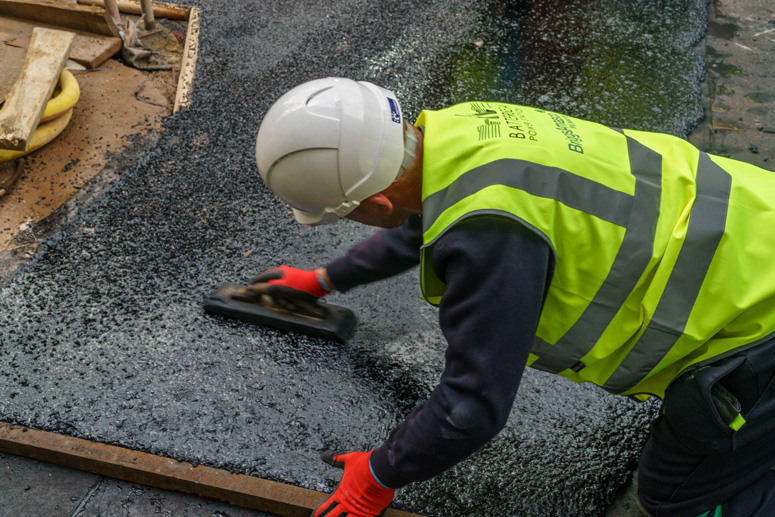 Seamlessly applied at the base of each chimney, mastic asphalt was layered at a precise 20mm thickness, covering a total of 750m². Beyond the chimneys, the same durable material was used to create a custom peregrine falcon’s nest, measuring 1m², within the chimneys. This addition provided a safe, rot-resistant, non-toxic home for the birds, ensuring that both wildlife and heritage were protected for future generations.
One of the key strengths of mastic asphalt in heritage work is its ability to accommodate complex detailing. At Battersea Power Station, this was evident not only at the chimney bases but also in numerous junctions, upstands and interfaces with other materials.
Mastic asphalt can be dressed into corners, around penetrations and across changes in plane without the need for joints or seams. This eliminates many of the potential weak points associated with sheet-based systems. For heritage structures, where water ingress can have serious consequences for both structural integrity and historic fabric, this level of reliability is essential.
In addition, the material’s inherent flexibility allows it to absorb minor movements within the structure – particularly important in older buildings where differential movement may occur between original and newly constructed elements.
By prioritising innovative materials and sustainable practices, BriggsAmasco and IKO successfully worked together to safeguard Battersea Power Station’s revamped infrastructure, preserving its heritage and enhancing its environmental performance.
Every aspect of the project was carefully tailored to meet unique installation needs and sustainability goals. From using zero-emission equipment during the waterproofing process to sourcing 99.9% of materials locally and within the UK, the project set a benchmark in eco-friendly construction.
Reflecting on the success of the project, Tony Lawther, Managing Director of BriggsAmasco said: “Collaborating with IKO on the Battersea Power Station project was a privilege and an exciting challenge. Together, we created solutions that not only respected the legacy of this iconic structure but also integrated innovative, sustainable materials and processes. We proudly pushed the boundaries of modern waterproofing technology to ensure that the revitalised Battersea Power Station stands out as a contemporary yet historically-significant landmark, demonstrating what’s possible when sustainability and heritage meet.”
As the industry continues to address the challenges of conserving the UK’s built heritage, the example set by Battersea Power Station is clear. Traditional materials, when specified and applied correctly, remain indispensable – and mastic asphalt continues to stand at the forefront of that capability.
This article featured within the 2026 Traditional Roofing supplement of Roofing Today – click here to view the article.